
Your Parent Doesn't Need a $300 Wall-Mounted AI Sensor. They Need a Grab Bar.
How high-tech fall detection became a guilt-mitigation tool that ignores how people actually break their hips.
Last month, a friend spent $800 on an AI-powered camera system that promises to detect falls using "predictive gait analysis." Three weeks later, his 78-year-old mother tripped over a curled rug corner in her hallway, broke her pelvis, and lay on the hardwood for two hours because the camera's line of sight was blocked by a half-open bathroom door. The system didn't fail; it behaved exactly like a camera in an empty hallway. We are buying our peace of mind in $50 monthly subscription increments, and it is costing our parents their mobility.
The direct answer
Premium AI fall-detection systems are reactive guilt-mitigation tools, not preventive safety measures. They do not prevent falls; they merely catalog them after the damage to a hip or pelvis is already done. True safety requires physical, boring home modifications—like removing low-profile rugs, adding structured lighting, and installing stud-mounted grab bars—which actually stop the fall from happening in the first place.
The Fall-Detection Fallacy and the Illusion of Safety
We love technology because it lets us solve hard, physical problems from our smartphones while sitting in a suburban office park thirty miles away. You buy the $400 radar disk, pay the $30 monthly monitoring fee, and check the app to see a green checkmark indicating "No Falls Detected." It feels like a resolution, but it is actually a distraction. The technology is designed to alert emergency services after bone meets hardwood, which is already too late for a 78-year-old whose physical independence drops by fifty percent after a single hip fracture.
Furthermore, these systems suffer from a massive false-alarm problem. A dog jumping on the couch, a dropped heavy blanket, or a sudden sit-down can trigger an automated call from a monitoring center, leading to parent frustration and, eventually, them unplugging the device entirely. Conversely, many slow slides to the floor—where a person gently slips down a wall because of a sudden drop in blood pressure—are missed entirely by algorithms trained on high-impact drops. You are paying for a high-tech smoke detector that only rings after the house has already burned to the ground.
To make matters worse, tech companies design these products for pristine, open-concept test homes, not the cluttered reality of a house lived in for forty years. A stack of old National Geographics, an extension cord running across the doorway, or a favorite armchair positioned just so can create massive blind spots for wall-mounted optical and radar systems. When we rely on these digital sentinels, we ignore the physical friction of the home environment that actually causes the instability.
The Real Numbers Behind the First Forty-Eight Hours
Let's talk about the math of a fall, because the marketing materials for these AI devices certainly won't. The primary danger of a fall isn't just the initial impact; it is the "long lie"—spending more than twelve hours on the floor unable to get up. A long lie leads to dehydration, muscle breakdown, hypothermia, and pressure ulcers, which are often more dangerous than the fracture itself. If your parent is wearing a pendant they hate and left it on the nightstand, or if the AI camera is in the kitchen while they are in the bedroom, they are still subject to this clock.
Compare the $500-a-year subscription cost of these systems to the cost of simple, physical intervention. A standard, high-quality grab bar costs $30, and hiring a local handyman to mount it securely into a wall stud costs about $150. A pack of low-voltage LED motion-activated strip lights for the hallway costs $25. These are one-time, analog expenses that physically support a human body when balance fails, yet we routinely bypass them in favor of recurring digital subscriptions that offer zero physical support.
When we look at the data from emergency room admissions, the vast majority of trips occur in two specific zones: the transition from bed to floor in the middle of the night, and the transition out of the shower. No algorithm can physically assist a person during these transitions. A stud-mounted vertical grab bar at the bathroom entry and a solid, non-slip step-in shower conversion are what actually save lives, not a sensor that texts you a notification while you are in a meeting.
The Hard Truth About Why We Choose Tech Over Timber
The hard truth is that buying an AI sensor is easy, while modifying a parent's home is hard. Buying tech requires a credit card and a Wi-Fi password. Modifying a home requires having a difficult conversation with a parent who views grab bars as a concession to old age and a sign of looming decline. We use technology as a buffer to avoid the emotional weight of acknowledging that our parents are growing frail.
If you tell your mother she needs a grab bar in the shower, she might get defensive, seeing it as an insult to her independence. If you give her a sleek, white plastic puck that looks like an Apple product and tell her it is a "smart home safety system," she is far more likely to accept it, even though it does nothing to help her stand up from the toilet. We are prioritizing our parents' short-term pride—and our own discomfort with difficult conversations—over their actual physical safety.
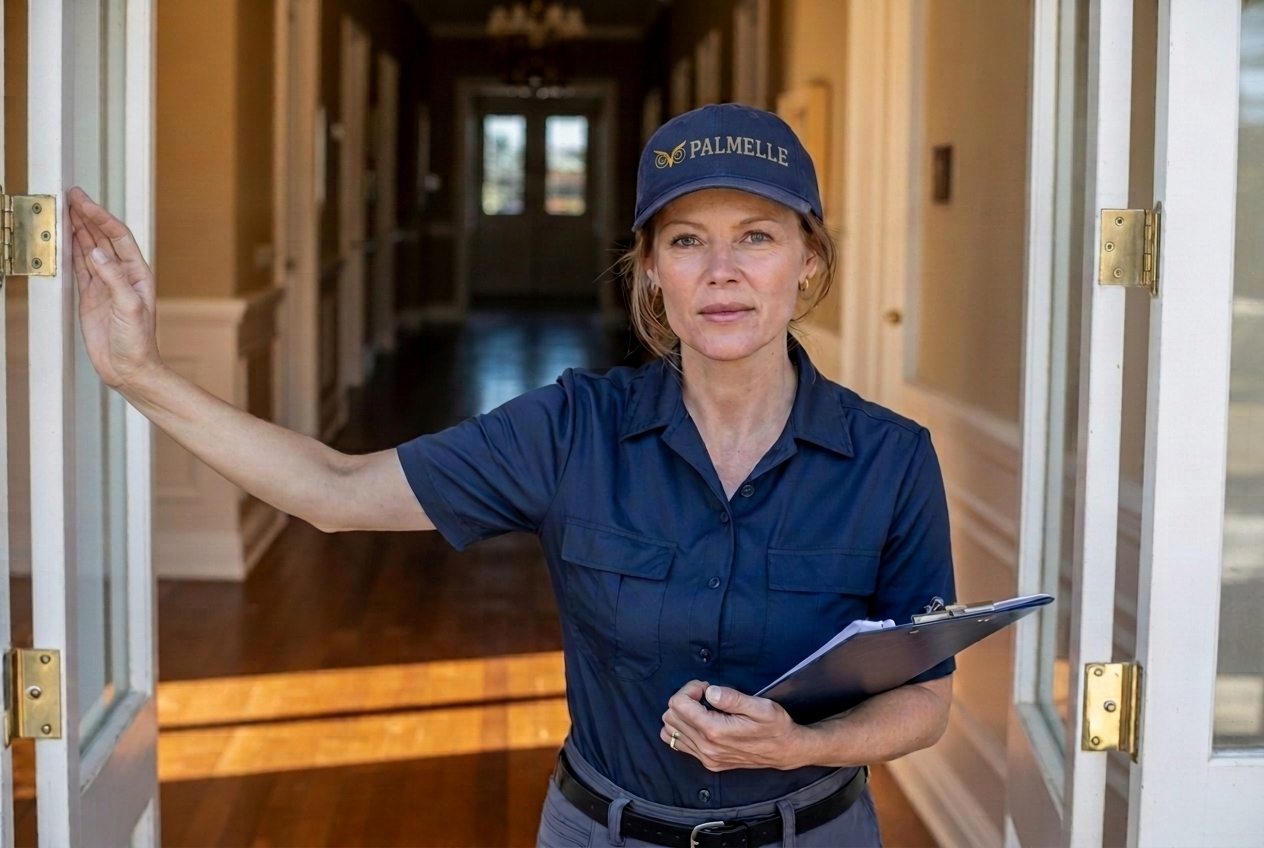
This is where professional eyes make the difference. A Certified Aging-in-Place Specialist (CAPS) doesn't look at a home through the lens of technology; they look at it through the lens of human biomechanics. They evaluate lighting thresholds, floor transitions, cabinet heights, and stair handrails to create a physical environment where falls simply do not find a place to happen. Palmelle offers a detailed CAPS-certified Home Safety Assessment for $399, which provides a concrete, actionable blueprint for physical modifications, rather than a digital band-aid that merely watches your parent struggle in high-definition.
Common mistakes
- Relying on wearable pendants that end up on the nightstand
Parents hate wearing pendants because they feel like badges of vulnerability, meaning they are almost never wearing them when they actually fall. Instead of wearable tech, focus on passive physical safety measures like high-contrast step-edge tape and solid handrails on both sides of every staircase. - Installing grab bars with suction cups instead of stud-mounting
Suction-cup grab bars are a disaster waiting to happen; they cannot support the sudden, high-velocity weight of a falling adult and will pull away from the tile. Always hire a professional to drill into wall studs, or use heavy-duty toggle anchors designed specifically for grab bar installation.
Frequently asked
Do AI fall detectors actually work?
They work under ideal conditions to detect rapid changes in elevation and velocity, but they are highly prone to both false positives and false negatives. They cannot detect slow, sliding falls where a person gradually slumps to the floor due to weakness or dizziness. Most importantly, they do not prevent the fall; they only alert you after the injury has occurred, which does not solve the primary danger of physical trauma.
What are the most critical home modifications to prevent falls?
The three highest-impact modifications are installing stud-mounted grab bars in the tub and next to the toilet, removing all throw rugs or securing them with heavy-duty double-sided tape, and upgrading hallway and staircase lighting to at least 800 lumens. These three changes eliminate over sixty percent of common household trip hazards. You can find trusted local contractors to execute these changes through our curated directory at /home-services.
How do I convince my parent to let me install grab bars?
Frame the modification around preservation of independence and style rather than aging and disability. Modern grab bars come in high-end finishes like brushed brass and matte black, looking more like premium bath hardware than institutional fixtures. You can also frame it as a home upgrade for general safety—much like installing a smoke detector—rather than a targeted intervention for their personal decline.
Sources
More from Home & Safety → · Back to Perch · Browse all stories