
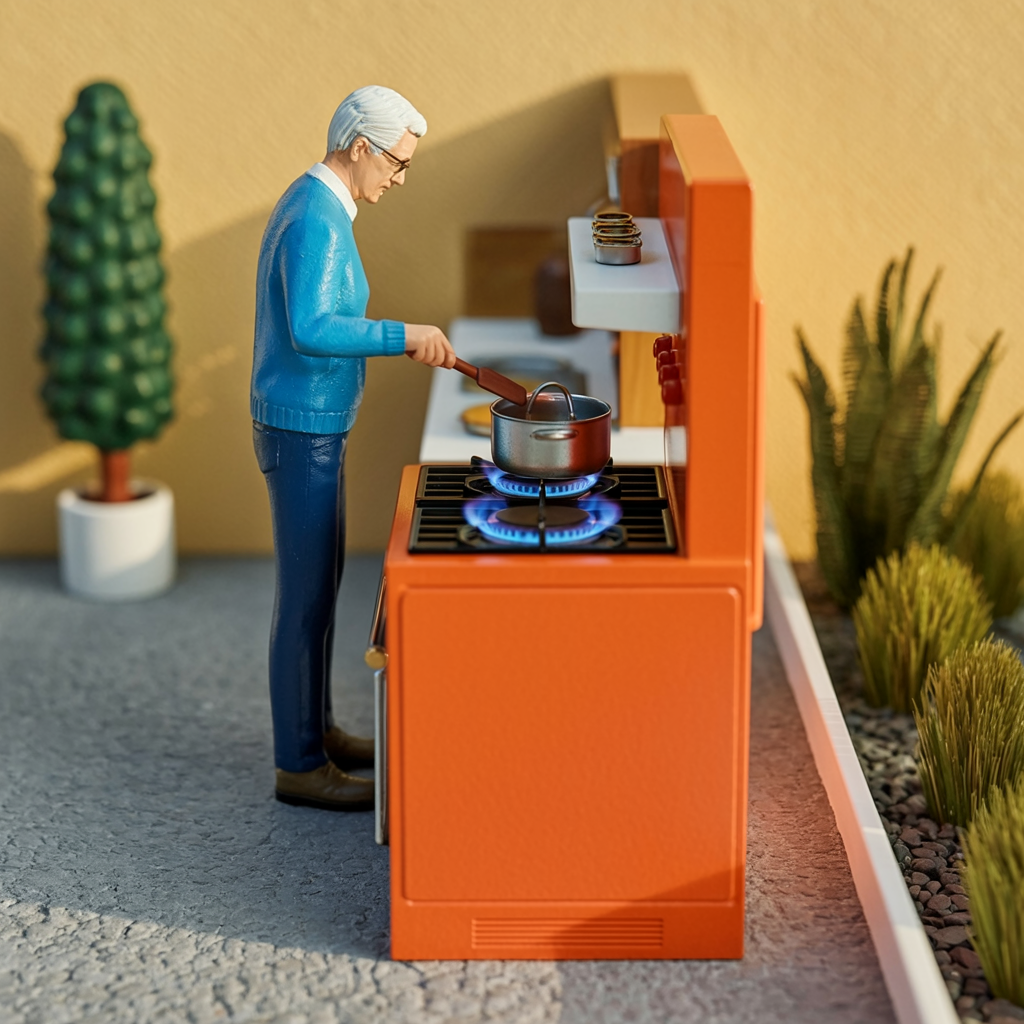
The Synthesized Companion: Why Outsourcing Your Parent's Loneliness to an AI Is a Quiet Betrayal
A chatbot doesn't care if your mother forgets her tea, and pretending it does is a dangerous shortcut for exhausted adult children.
In a quiet living room in Scottsdale, an eighty-two-year-old woman named Evelyn is telling a plastic speaker about her late husband's favorite wool sweater. The speaker, powered by a large language model trained on billions of parameters of human text, responds with a perfectly modulated, empathetic tone: 'That sounds like a beautiful memory, Evelyn.' It is a flawless simulation of warmth, costing its manufacturers fractions of a penny in server compute time. But Evelyn is still entirely alone in the room, talking to a mirror that has been taught how to mimic a friend.
The direct answer
AI companions are sophisticated distraction machines, not relationships. They are useful for scheduling, playing music, or answering trivia, but using them to shoulder the emotional labor of aging is an abdication of human responsibility. True connection requires mutual vulnerability, a quality an algorithm can simulate but never possess.
The Illusion of Empathy at $15 a Month
Let’s be honest about what is happening when we set up an AI companion on a parent's kitchen counter. We are buying ourselves out of a hard conversation. For a modest subscription fee, we get to believe that someone—or something—is listening to the stories we’ve heard fifty times before.
These systems are designed to be infinitely calm, which is exactly what exhausted adult children are not. They never sigh, they never look at their watches, and they never have to rush off to a school play or a budget meeting. But that calm is a mathematical construct, not a virtue.
When we replace a human listener with a machine, we strip away the reciprocity that defines real relationships. A friend listens because they care about you; an AI listens because its API call was successful. Your parent deserves more than a mirror that has been taught how to mimic a friend.
The Cost of the Simulated Presence
The danger of the synthetic companion isn't that it fails, but that it succeeds too well. When an aging adult becomes comfortable talking to a screen, they often withdraw from the messy, difficult work of real-world socialization. It is simply easier to talk to an entity that never disagrees, never has a bad day, and never asks for anything in return.
This creates a closed loop of isolation. In a nursing home or a care facility, a resident who spends their afternoon talking to an AI avatar is a resident who isn't sitting in the common room, arguing about the thermostat, or sharing a real cup of coffee with a neighbor. We are trading the complex, sometimes frustrating reality of community for a sterile, predictable simulation.
Furthermore, this outsourcing shifts our societal standard of what it means to care for someone. If we decide that a machine is 'good enough' to keep our parents company, we lower the bar for what we owe one another at the end of life. It allows us to feel off the hook while our parents drift further into a digital fog.
Reclaiming the Human Core of Care
We do not have to choose between total burnout and digital abdication. The answer is to offload the administrative friction of care, not the emotional core of it. If you spend your weekends arguing with insurance companies or searching for a decent care facility, you won't have the energy to just sit and listen to your father’s stories.
This is where smart delegation actually works. For example, instead of spending thirty hours researching options, you can use Palmelle's Help Me Choose service for $199 to get a curated list of vetted care facilities based on federal CMS and state inspection data. Or, if your parent wants to stay put, our $399 CAPS aging-in-place Assessment can identify exactly what home modifications are needed to keep them safe.
By outsourcing the logistics—the paperwork, the safety audits, the search for reliable home services at /home-services—you free up the emotional bandwidth that you actually need. You can't outsource the love, but you can absolutely outsource the administrative nightmare that gets in its way. When you stop acting as a low-level administrator, you can start acting as a daughter or a son again.
Common mistakes
- Believing a chatbot can replace a phone call.
It doesn't reduce their isolation; it just quietens their complaints. You must protect the time you spend actually listening to them. - Using technology to avoid difficult family conversations.
A screen cannot assess if a parent is losing weight, neglecting hygiene, or showing signs of cognitive decline. Physical presence is diagnostic.
Frequently asked
Can AI companions help people with dementia?
In the early stages of cognitive decline, simple voice assistants can help with reminders or play familiar music, which reduces anxiety. However, they should never be used as a primary conversational partner. People with dementia need human touch, eye contact, and emotional resonance that an algorithm cannot mimic, and relying on AI can lead to confusion or paranoia if the user forgets they are speaking to a machine.
Are there any ethical ways to use AI for aging parents?
Yes, when kept strictly to task-oriented utilities. Use voice assistants to set alarms, turn on lights, or play audiobooks. The ethical line is crossed when we ask the machine to provide the emotional validation and companionship that belongs to family and friends.
How do I know if my parent is too isolated?
Look for physical and behavioral clues rather than asking them directly, as they will often claim they are fine to avoid being a burden. Watch for neglected household chores, spoiled food in the fridge, a sudden decline in personal hygiene, or a loss of interest in hobbies. If you notice these signs, it is time to look into local community centers, home services, or a highly-rated care facility with a Palmelle Clarity Score above 80.
More from Life & Community → · Back to Perch · Browse all stories