
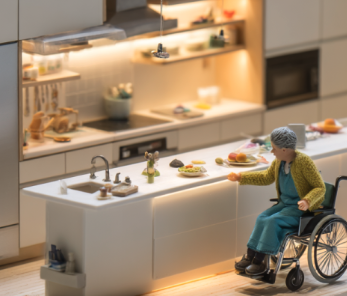
The Solo Aging Tax: What Staying in Your Home Past 75 Actually Requires
Aging in place isn't a passive default; it's a high-stakes logistics operation that starts with your plumbing and ends with your legal proxy.
Most people treat 'aging in place' as the default plan, which is another way of saying they haven't planned at all. They picture themselves drinking coffee on the porch at 78, ignoring the fact that the porch has three rotting steps and the main bathroom is on the second floor. The reality of solo aging isn't a quiet continuation of your fifties; it is a complex, capital-intensive logistics operation that requires a hard-nosed audit of your home and your budget.
The direct answer
Living alone at 75 requires three concrete assets: a home modified for physical frailty before you actually need it, a local network of paid professionals rather than relying on neighbors, and a minimum of $3,000 to $5,000 in monthly discretionary budget to outsource physical labor. If you do not have these three elements in place by your late sixties, your choice to stay home will likely be made for you by an unexpected fall or an emergency room discharge planner.
The Physical Tax: Your House Is Actively Trying to Evict You
Your home was built for a thirty-year-old body. The standard 36-inch counter heights, deep bathtubs, narrow door frames that cannot accommodate a walker, and basement laundry machines are all design hazards waiting to happen. To stay in your home past 75, you must run a cold-eyed audit of these physical barriers before you turn 65.
A real retrofitting is not cheap. Widening three doorways, converting a tub to a curbless walk-in shower, and installing proper task lighting throughout the halls can easily run $15,000 to $30,000. If you need a ramp or a stairlift, add another $3,000 to $12,000 depending on the layout.
This is why Palmelle offers a professional Assessment for $399, employing Certified Aging-in-Place Specialists (CAPS) to map out these exact physical liabilities before they become emergencies. Ignoring these physical updates means you are one slick tile away from a fractured hip. Statistically, one-third of adults over 65 fall each year, and for a solo ager, a fall without a plan is the fastest path to an unwanted, permanent stay in a nursing home.
You can pay for the modifications now on your own terms, or you can pay for them later under the duress of an urgent hospital discharge.
The Social and Logistics Tax: You Cannot Outsource Intimacy, But You Must Outsource Labor
We like to think our friends and neighbors will look out for us, but relying on informal networks is a dangerous strategy for a solo ager. Your friends are aging too, and your neighbors have their own careers, kids, and mortgages. To survive alone at 75, you need to build a professional, paid infrastructure for the things you can no longer do safely.
This means budgeting for regular home maintenance, gutter cleaning, lawn care, and grocery delivery. It also means hiring professional help when tasks like changing a lightbulb in a high ceiling or carrying salt bags for the water softener become physical risks. These small, seemingly trivial tasks are the friction points that slowly wear down an independent lifestyle until the home becomes unmanageable.
You can explore vetted providers for these tasks through platforms like Palmelle's /home-services directory. The goal is to transition from DIY to a project manager of your own life, treating your home's upkeep like a business expense rather than a weekend hobby.
The Hard Financial Reality: The Commission-Driven Trap and What It Actually Costs
Many people assume that if staying home doesn't work out, they will simply transition to a nice care facility nearby. They search online and quickly fall into the clutches of commission-based referral platforms like A Place for Mom, Caring.com, or SeniorAdvisor. These platforms present themselves as free, objective guides, but they operate on a simple model: they only show you facilities that pay them a hefty finder's fee, often equal to one month's rent.
This commission-driven model hides the best local options and covers up crucial safety records. They will not tell you about the nursing home down the street that has a history of understaffing or safety violations. At Palmelle, we bypass this conflict of interest entirely by calculating a Palmelle Clarity Score from 0-100, computed directly from federal CMS and state inspection data, giving you the unvarnished truth about safety and quality.
If you choose to stay home, the cost of bringing in private, non-medical home care averages $30 an hour across the United States. If you need just 20 hours of help a week with meal prep, bathing, and transportation, that is $2,400 a month. That is on top of your mortgage, property taxes, utilities, and food, proving that independent living is rarely the low-cost alternative people think it is.
Common mistakes
- Confusing 'independent' with 'isolated'
Staying in a suburban home where you must drive to buy a gallon of milk is not independence; it is a self-imposed quarantine. If you can no longer drive safely, isolation leads to rapid cognitive decline and depression. - Waiting for a crisis to designate a legal and financial proxy
If you do not choose a trusted legal proxy and durable power of attorney while you are fully healthy, a probate judge might choose one for you during a health crisis. This leaves your assets and care in the hands of state-appointed strangers.
Frequently asked
How much does it cost to modify a home for solo aging?
A basic entry-level modification, including grab bars, improved lighting, and minor threshold ramps, ranges from $1,500 to $5,000. Extensive renovations, such as installing a curbless walk-in shower, widening doorways, and adding a first-floor laundry room, typically cost between $15,000 and $40,000 depending on your location and home layout.
What is the difference between a care facility and a nursing home?
A care facility generally refers to assisted living or memory care, designed for people who need help with daily activities like meals and bathing but do not require constant, around-the-clock nursing care. A nursing home provides continuous skilled nursing care and rehabilitation services for individuals with complex physical needs, and is heavily regulated by federal and state agencies.
Is staying at home always cheaper than moving to an assisted living facility?
Not necessarily. While staying in a paid-off home seems free, the combined costs of home maintenance, property taxes, retrofitting, and hiring private home care at $30 an hour can easily exceed the $4,500 to $7,000 monthly cost of an assisted living facility. If you require more than 30 hours of private home care per week, moving to a care facility is almost always more cost-effective.
Sources
More from Your Own Future → · Back to Perch · Browse all stories